Stop climate change: Difference between revisions
(→Other) |
|||
| (One intermediate revision by the same user not shown) | |||
| Line 12: | Line 12: | ||
* [[Make neighborhoods walkable]] | * [[Make neighborhoods walkable]] | ||
===Produce less stuff=== | ===Produce less stuff=== | ||
{{preamble|(without sacrificing quality of life)}} | <!--{{preamble|(without sacrificing quality of life)}}--> | ||
====Electronics==== | ====Electronics==== | ||
* [[Right to repair]] | * [[Right to repair]] | ||
| Line 26: | Line 26: | ||
* [[Stop home waste]] | * [[Stop home waste]] | ||
* [[Make clothes last longer]]? {{talk|Need to distinguish between "they should manufacture stuff better quality" (which might actually have a ''higher'' environmental footprint in some cases), vs "how make your clothes last longer even when they're cheap. Repair, take care, etc." (which is probably what we really need. Some of it is lifestyle choices, but I bet some systemic changes could help too, like better access to tools for repairs, and more education on how to use them).}} | * [[Make clothes last longer]]? {{talk|Need to distinguish between "they should manufacture stuff better quality" (which might actually have a ''higher'' environmental footprint in some cases), vs "how make your clothes last longer even when they're cheap. Repair, take care, etc." (which is probably what we really need. Some of it is lifestyle choices, but I bet some systemic changes could help too, like better access to tools for repairs, and more education on how to use them).}} | ||
' | |||
===Heating & cooling=== | |||
We're still discussing what solutions are really suitable for the average home or building. [[How much less energy could be used in heating & cooling buildings, in most cases?|Join the discussion.]] | |||
==Note== | |||
''Systemic changes'' might not be enough without some ''lifestyle changes''. A lot of middle-class people will still have to choose to consume less, in some ways. | |||
{{talk|TO DO: Add specific examples of wasteful consumption habits. Talk about how to do better.}} | {{talk|TO DO: Add specific examples of wasteful consumption habits. Talk about how to do better.}} | ||
{{talk|Half of emissions come from the richest 10% of the world. This ''includes'' '''most people''' who live in "first world" countries.<br />[[Image:carbon-inequality1.png|link=]]}} | {{talk|Half of emissions come from the richest 10% of the world. This ''includes'' '''most people''' who live in "first world" countries.<br />[[Image:carbon-inequality1.png|link=]]}} | ||
We can still have nice things, just not replace them so often. | But it's not as bad as it sounds. We can still have nice things, just not replace them so often. | ||
Economic degrowth shouldn't reduce quality of life. It has to be done the right way. It can actually make our lives better by enabling us to [[shorten the work week and lower the cost of living|work less]]. | |||
Latest revision as of 16:23, 26 February 2026

Fossil fuels are still the world's main energy source, and still the main cause of climate change.
- We need to switch to other energy sources, but:
- They each have their own limitations and environmental impacts as well. So we also need to not use so much energy in the first place. Not the old "save energy by turning off the lights" rhetoric which misses the big picture. Most of the world's energy usage is actually for:
- Producing & transporting goods (i.e. stuff people buy)
- Driving cars
- Heating & cooling homes / buildings
Things we must do
Reduce the need for driving
Produce less stuff
Electronics
Even though agriculture isn't the biggest source of carbon emissions, it is the biggest destroyer of wildlife. We need to feed the world using less resources:
- Stop food waste
- Stop biofuels
- Make the food supply more plant-based
- Improve crop yields in some cases
Other
Heating & cooling
We're still discussing what solutions are really suitable for the average home or building. Join the discussion.
Note
Systemic changes might not be enough without some lifestyle changes. A lot of middle-class people will still have to choose to consume less, in some ways. But it's not as bad as it sounds. We can still have nice things, just not replace them so often.
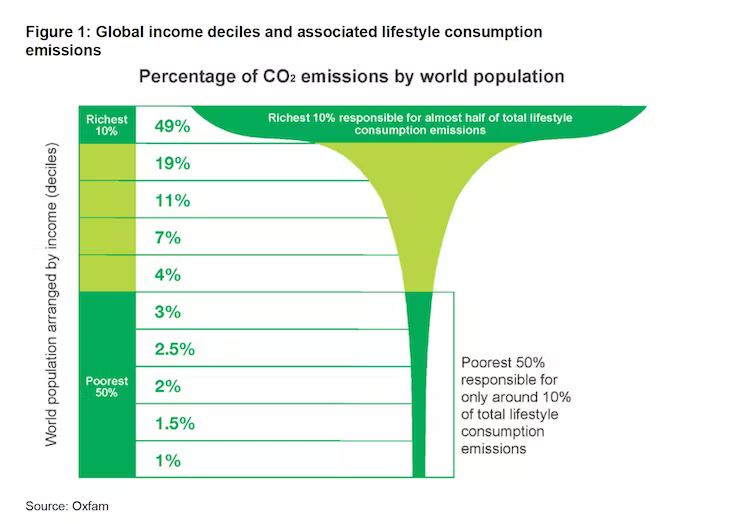
Economic degrowth shouldn't reduce quality of life. It has to be done the right way. It can actually make our lives better by enabling us to work less.